The first and foremost upgrade cyclists and triathletes make on their bike to go faster is often deep-section carbon wheels, and honestly, why not!
They're lighter, they're stiffer. They help you accelerate better. They look and sound so good. They improve your performance....but do they?
Well, of course they do!
But are they the best bang for your buck?
I doubt so, and I'd like to provide a different opinion.
Now, before I go on to tell you why, let me make it clear: I'm NOT anti-carbon wheels. I use them too for all my racing, and I don't even remember the last race I did without them. But that still doesn't change my opinion on them (without denying their benefits).
Let's first talk about how/why carbon wheels make you go faster. This comes down mainly to 2 things:
Weight and stiffness: Since they're lighter than the usual aluminium pair, usually around 200-800 grams, they reduce the overall mass of the bike. While the benefits of this are negligible on flats, minute on climbs (unless you're racing at the highest levels and at double-digit gradients), the biggest benefit of lighter carbon wheels comes from acceleration.
This is particularly useful in road racing. Every attack, surge, sprint, or acceleration requires energy, and reducing rotational mass definitely has its benefits.
Depth: Carbon wheels are engineered to cut through wind. Companies invest massively in R&D to ensure optimal aero profiling, saving every ounce of watt possible.
This translates to roughly 5-15 watts depending upon riding speed, wind speed, wind angle, and a whole host of things, keeping in mind the faster you go, the better carbon wheels perform (they wouldn't help much at 20-25 kmph).
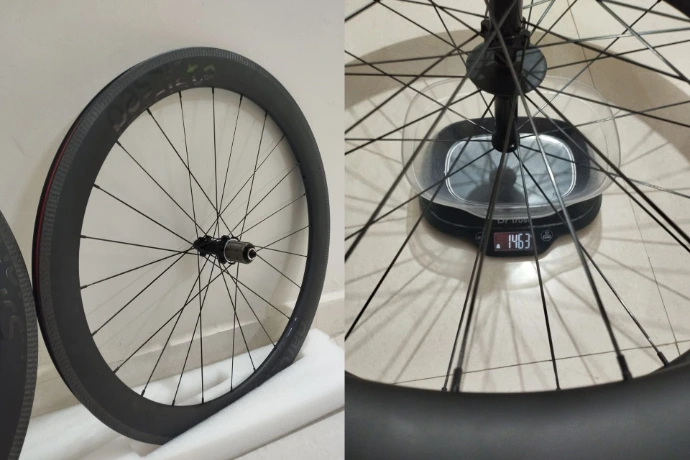
So the benefits are objectively real.
But what if I told you, instead of saving these watts, you could gain them? What if you could effectively map out your power and track and improve it over time?
That's exactly what a power meter does.
A power meter is a device that measures the work you're doing on the bike in terms of watts.
When you ride, two things matter:
The force you put down to spin the pedals
How fast you spin the pedals (cadence)
A power meter measures exactly those: the force that you put down through your legs and how fast you put it down (cadence), resulting in watts (power).
How you use it is an entirely different and in-depth topic of discussion (which I'll definitely cover later), but let me give you an overview of the benefits and why these matter more than aero wheels.
Power Meters Remove Guesswork: Watts Don't Lie
Most endurance athletes are very familiar with using pace and/or HR for training, and for good reason. They help define training zones, track improvements, and assist with pacing.
A power meter does all of those things too, but refines them a notch further.
Unlike metrics such as speed and HR, power (watts) is not heavily influenced by external variables.
Think about it. Your average speed can fluctuate depending on the route, wind conditions, aerodynamics, traffic, and so much more.
Heart rate is slightly better in this regard, but it can still be influenced by weather, sleep, caffeine, stress, fatigue, and other factors.
A power meter tackles exactly this problem.
Two hundred watts is two hundred watts irrespective of route, wind, or weather. If the power you're able to sustain for a given duration is increasing over time, you're objectively improving.
Power Meters Improve Pacing
A power meter helps you define your zones more accurately and, if you've used that data correctly in training, allows you to pace your efforts far more effectively.
This holds true for cyclists in individual time trials, road races, and distance events such as BRMs. It is especially useful in triathlon, where pacing on the bike can have a massive impact on the run that follows.
Knowing your limits allows you to ride right on the edge without crossing it.
Heart rate can also be misleading during races and events because excitement, nerves, and adrenaline often push it higher than normal.
Power gives you a much clearer picture of the work you're actually doing.
Power Meters Refine Fuelling
This is one of the less talked about benefits of power meters.
Unlike HR, which is relatively ineffective for estimating caloric expenditure, a power meter is very accurate at measuring your work rate and, therefore, the energy you're expending.
The formula is as simple as:
3.6 × Average Power × Time (in hours)
So a cyclist riding at 150w for 2 hours burns:
3.6 × 150 × 2 = 1080 calories
This can help refine your on-the-bike fuelling considerably.
You probably don't need to mimic the pros consuming over 100g of carbs per hour if you're not producing anywhere near the same power output.
It can also help you estimate your Total Daily Energy Expenditure (TDEE) much more accurately, which is particularly useful for athletes with weight loss or weight gain goals.
Watts tell us what's going inside
A power meter, when paired with the right testing and interpretation, can tell us a lot about you as a rider, the kind of information we simply can't extract from HR alone.
We can gain insights into your muscle fibre dominance, AWC (W' Prime), VO₂ max (to a decent extent), fractional utilization, and much more.
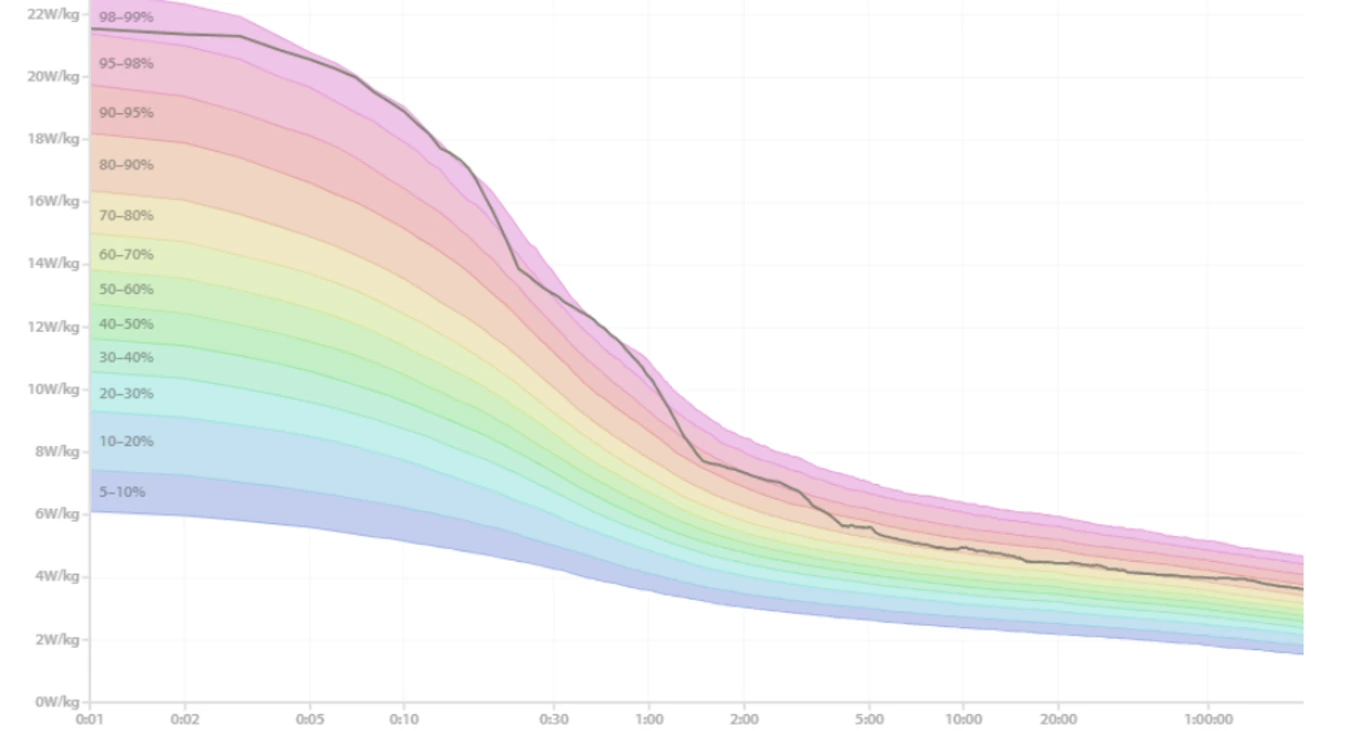
These data points help us identify strengths, weaknesses, and the physiological demands of your goal event, allowing training to be tailored accordingly.
For example, a triathlete with very high AWC but low fractional utilization would likely require a different training approach than an athlete with low MAP but high fractional utilization.
Training with watts shifts the conversation from following a generic plan to building training around the athlete's physiology.
Best Power Meter Options in India (2026)
Favero Assioma Duo | MRP ₹59,999 to ₹84,999
Arguably the gold standard of power meter pedals. Simple, accurate, and just works well! The recent discounts have also made them a lot more affordable. The PRO RS 2 (Shimano cleats) variant is also an option but costlier than the standard LOOK one.
Magene P715 Pedal-Based Power Meter | ₹51,900
Just like the Favero Assioma, Magene's P715 pedal-based power meter can be easily swapped between different bikes. Though relatively new in the Indian market, the reviews so far, both from India and globally, have been highly positive. Even with a modest LBS discount, these are your most VFM power meters within the ₹45-50K range.
Magene PES-P515 Spider-Based Power Meter | MRP ₹33,900
These are the most affordable dual-sided power meters currently in the Indian market. With a claimed accuracy of ±1%, these should definitely be on your bucket list. The only slight downside is that if you've multiple bikes, you can't swap the power meter as easily as the pedals.
4iiii Precision 105 Single-Sided Crank Arm | MRP ₹29,500
This is a single-sided power meter by 4iiii that goes on the non-drive side of the crank. It is definitely good enough for training (my first power meter was a single-sided crank arm). With the Magene PES-P515 available at a similar price point, this is a difficult choice, given the potential caveats of only one-leg power measurement and compatibility issues with non-Shimano cranks.
Despite everything, this is the most affordable power meter and definitely good enough for training.
Final Thoughts
Carbon wheels make your bike faster. Power meters make you faster.
One improves the equipment. The other improves the engine.
And unless you're already training with power, understanding your physiology, pacing correctly, and fuelling appropriately, there's a good chance a power meter will provide greater performance gains than a deep-section wheelset ever will.
Buy the wheels eventually. Just don't buy them first.